
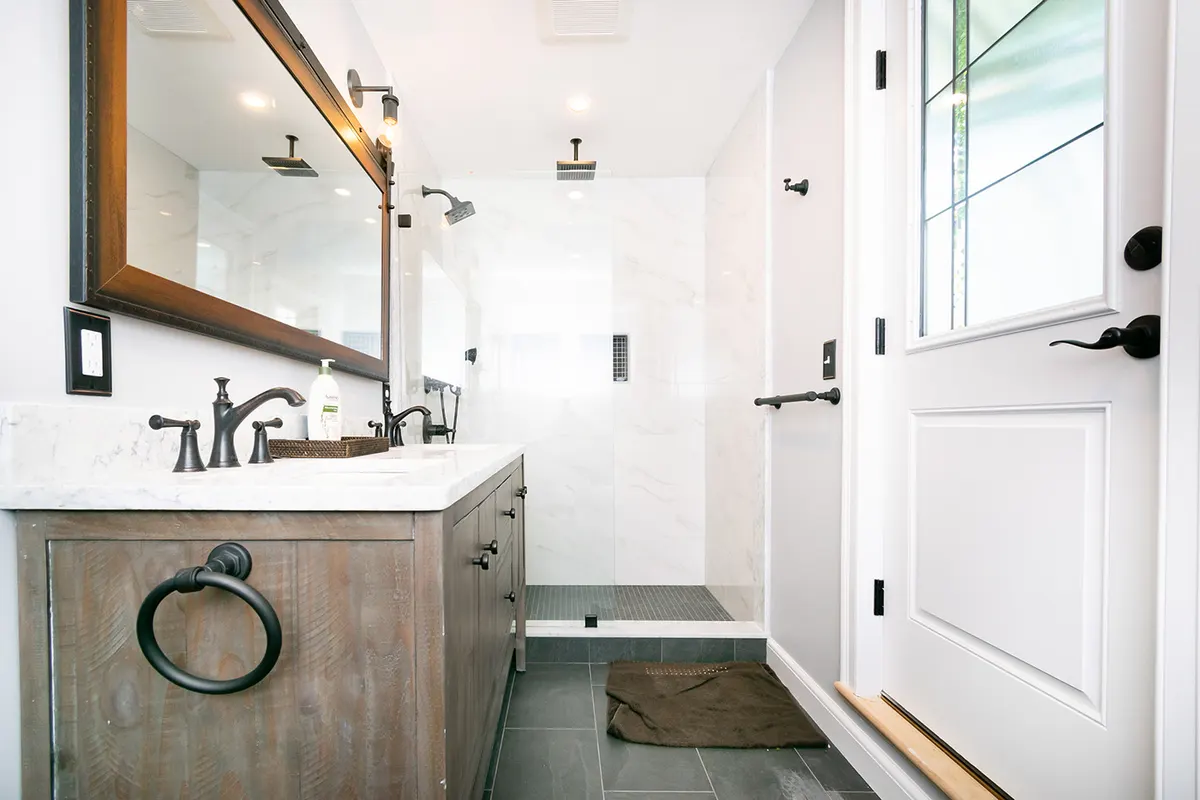
Most homeowners asking about soft-close drawers, ADA-height vanities, or curbless showers are really asking the same underlying question: how much more does the accessible or upgraded version cost compared to the standard one, and is the difference worth it.
Start with soft-close drawer boxes. The hardware itself, the undermount slides with the dampened close mechanism, adds a modest amount per drawer compared to standard side-mount slides. Where the cost climbs is in the box construction. Soft-close hardware performs best when paired with dovetail-jointed drawer boxes rather than stapled or doweled ones, because the repeated dampened impact over years of use stresses the joints. If you are already buying quality cabinetry, you are likely already getting this construction. If you are upgrading mid-range boxes to accept soft-close slides, the combined cost of better boxes plus hardware can add several hundred dollars to a vanity run, depending on drawer count. It is a real cost, but it is also one of the few upgrades that every person in the household notices every single day.
ADA-height vanities, typically set at 34 to 36 inches to the countertop rather than the standard 32, cost almost nothing extra in cabinet pricing, because the height difference is handled at rough framing and blocking rather than in the cabinet itself. The real cost consideration is the plumbing rough-in. If your existing drain and supply lines are already in the wall, raising the vanity height is straightforward. If the drain is in the floor and needs to be relocated to accommodate a taller cabinet with a different trap configuration, that is a plumber's half-day of work added to the project. In a full bathroom remodel where plumbing is already being opened up, this is usually absorbed without much impact. In a cosmetic swap where you are trying to avoid opening walls, it can change the math.
Curbless showers carry the most meaningful cost premium of the three. The floor has to slope to drain without a curb to contain water, which requires a linear or center drain set into a properly sloped mortar bed, a waterproofing membrane that runs continuously up the walls, and often a recessed or flush threshold at the entry. The tile work is more labor-intensive because every cut has to account for the slope. In a typical Greater Boston bathroom remodel, a curbless shower adds cost relative to a standard curbed pan; the range varies with shower size and tile complexity, but it is a real line item, not a rounding error. For aging-in-place purposes or households with mobility considerations, most clients find it worth it.
If you want to talk through which of these upgrades makes sense for your specific bathroom and budget, call us at (617) 397-5158 or visit baystateremodeling.com to schedule an in-home consultation.
Thinking about a project of your own
A 30-minute consult is usually enough to confirm whether we are the right fit.
Book a consult